
Both Resident Evil and Silent Hill are seminal franchises in the realm of video game horror, originating in the late 1990s with the debut of the first Sony PlayStation, and they continue to introduce new titles today.
However, Silent Hill’s psychological approach to horror has attracted a more specialized audience when compared to the mass appeal of Resident Evil.
Rather than featuring witty police officers and secret agents navigating a zombie apocalypse, Silent Hill immerses players in harrowing environments filled with ambiguous characters and metaphors that explore themes of past traumas and guilt.
Silent Hill: Townfall, brought to life by Konami and developed by Screen Burn Interactive from Glasgow, contains moments that exemplify the highest levels of horror in gaming today. Nonetheless, its eclectic mix of gameplay mechanics can sometimes feel disjointed, meaning you might find one aspect of it thrilling while disliking another.
Welcome to St. Amelia
Townfall’s opening scene is peculiar. It is 1996, and American Simon Ordell (voiced by The Leftovers‘ Jovan Adepo) washes ashore in St. Amelia, a deserted Scottish fishing village, completely unaware of how he arrived. An IV bag is fastened to his arm, with its tubing inserted into his left hand.
Protest signs litter the town square, suggesting a corporation may be responsible for a disaster. Simon answers a ringing payphone and converses with a man named Richard (Lost’s Terry O’Quinn), who instructs him to locate a nurse named Zoe Ellis (Kezia Burrows). Though she knows Simon, he has no recollection of her.
Once a lively fishing community, the town is now inhabited by grotesque, humanoid creatures that emit moans and growls despite their featureless faces.
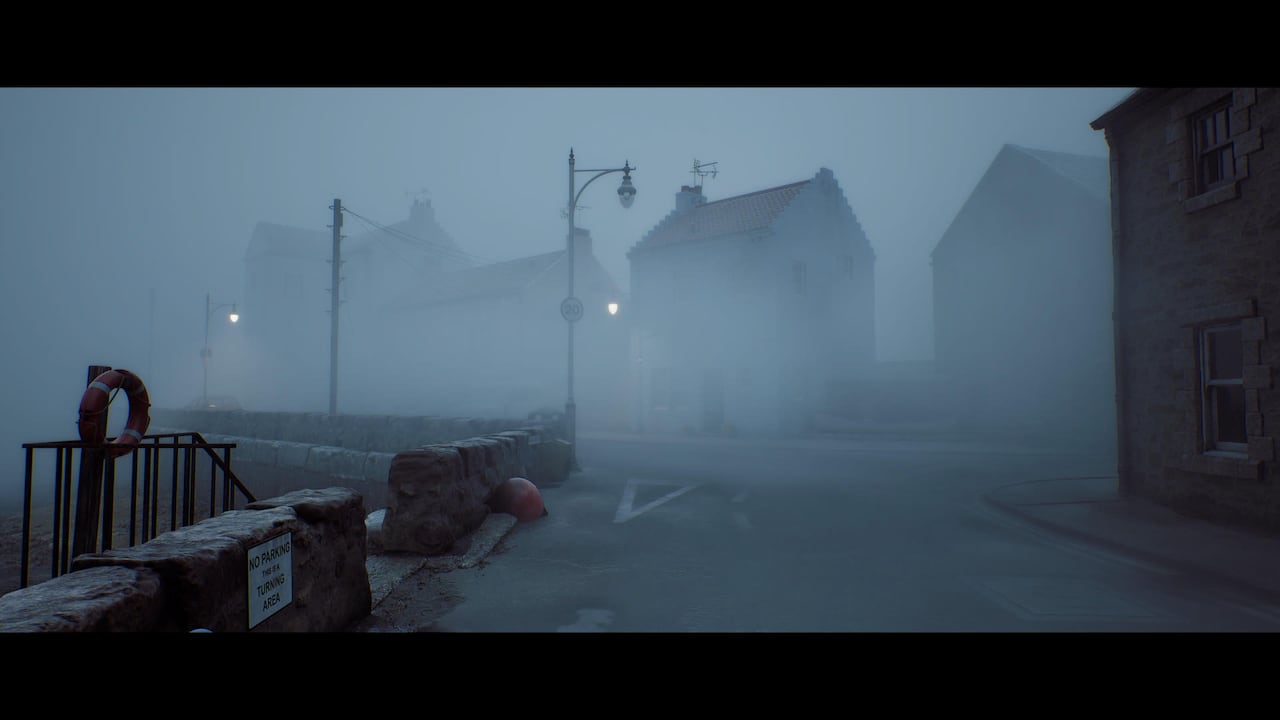
The unsettling, seemingly deserted Scottish fishing village of St. Amelia serves as the backdrop for Silent Hill: Townfall. (Screen Burn/Konami Digital Entertainment and Annapurna Interactive)
Crucial to Simon’s survival is the CRTV — a handheld portable television akin to Sony’s Sport Watchman. When tuned, it reveals the shivering outlines of enemies against a grainy red backdrop, enabling him to sneak past them without harm.
The CRTV transmits cryptic messages — visions of your desired location such as Zoe’s residence, or hints to unlock a rusty cabinet in a pharmacy’s storage area, occasionally accompanied by audio snippets from Zoe or Richard through its low-fidelity speaker.
Your arsenal for confronting adversaries is limited: a thrown bottle can divert their attention; a decaying wooden plank can withstand a single melee attack but will soon break. A handgun offers a powerful last resort, though ammunition is scarce and seldom sufficient to fill all six chambers.
This setup cultivates a sense of dread and powerlessness, compelling you to evade confrontations whenever possible.
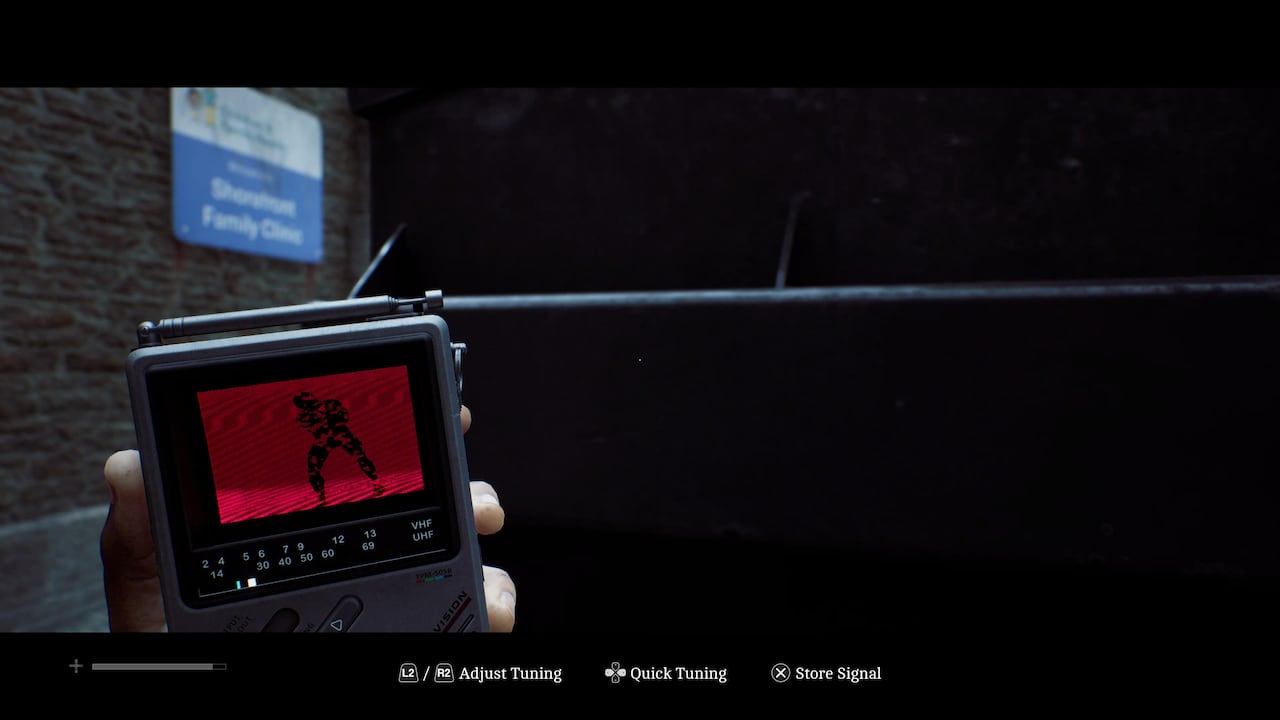
The CRTV, a portable handheld television device, enables players to locate clues and track enemy movements. (Screen Burn/Konami Digital Entertainment and Annapurna Interactive)
First-person stumbles
For the first time in the series, Townfall is played entirely from a first-person perspective, allowing players to experience everything through Simon’s eyes (though a few chapters put you in the roles of Zoe or Richard).
With your view limited to what is directly ahead, you constantly shift your gaze left and right, relying on audio cues and the CRTV to monitor nearby threats.

The protagonist dashes into a clinic and secures the door just in time to avoid a horrifying creature’s attack. (Screen Burn/Konami Digital Entertainment and Annapurna Interactive)
However, this shift comes with some challenges; prompts appear when you approach objects or items to interact with, but the symbols and text on-screen are often too small to read quickly.
Frequently, while trying to find a closet to hide from a pursuing monster, I lost valuable seconds searching for the “X” button prompt to appear. At times, while attempting to evade an enemy in a narrow hallway, I pressed the button thinking I was collecting a first-aid item — only to inadvertently slam a door shut in my face, leading to my demise.

Simon is on the hunt for Zoe Ellis (Kezia Burrows), a nurse who may hold the key to understanding his presence in St. Amelia. (Screen Burn/Konami Digital Entertainment and Annapurna Interactive)
Masters of unlocking
Silent Hill: Townfall shines brightest when you navigate portions of the town as if it were an enormous puzzle box, scouring spooky residences and alleyways to reach your next goal.
You’ll refer to your paper map, marked in red to indicate locked doors and areas you’ve already explored, planning your route while mentally noting locations of enemies and taking a deep breath before setting off in search of the next item or clue. Each step feels just close enough to entice you to follow the trail for hours on end.

Players will sift through old emails and programs on floppy disks using retro ’90s computers in Silent Hill: Townfall. (Screen Burn/Konami Digital Entertainment and Annapurna Interactive)
Much of your time will also be spent peering at ’90s-style computer displays, checking answering machines for messages next to landline telephones, or hunting for floppy disks and cassette tapes along the way.
This interest in vintage technology is a hallmark of developer Screen Burn, previously known as No Code, who effectively utilized the unsettling sound of a monitor’s low capacitor hum in their 2017 sleeper hit Stories Untold.
The Weight of it all
Things become increasingly perilous (and metaphysical) when St. Amelia is thrust into an alternate realm, possibly representing a fragment of Simon’s mind. This world is illuminated by a blood-red glow, with black iron pipes obstructing previously clear paths and enemies pursuing you in larger numbers.
This element is characteristic of Silent Hill games, further amplified by the presence of The Weight — a massive, grotesque entity that can eliminate you upon contact.
The “evade the menacing monster” aspect is a recurring theme in horror video games, and the team at Screen Burn includes members who contributed to Alien: Isolation, a standout in that subgenre.

Silent Hill: Townfall reaches its peak danger when it immerses you in a haunted alternate version of St. Amelia, suffused with a blood-red light. (Screen Burn/Konami Digital Entertainment and Annapurna Interactive)
Yet, this scenario can become frustrating, as The Weight often moves unpredictably and can occasionally position itself directly in front of your hiding spot, leaving you trapped for extended periods.
Most annoyingly, if it captures you, the game frequently respawns you right where you died — with The Weight still looming in front of you, creating a frustrating cycle of repeated deaths.
While the visuals in St. Amelia’s nightmare realm are initially striking, they can become monotonous over time.
It’s particularly disappointing because certain elements of “normal” St. Amelia stand out for their uniqueness. A flat in a corporate housing block twists and morphs seemingly at the whim of a series of haunted cassette tapes. Later, Richard attempts to scale an office building overrun with monsters, scavenging valuable shotgun shells left behind by those who met their demise before him.
Another attempt? For die-hards, maybe
After a grueling 18-plus hours spent in Silent Hill: Townfall, I reached one of the story’s conclusions. The game offers at least five alternate endings, each (ideally) illuminating the tragedy that befell St. Amelia — and the roles Richard, Zoe, and Simon played in it.
While the series is often more focused on atmosphere than a coherent narrative, I still found myself frustrated by the number of questions that remained unanswered — or how many additional times I would need to replay it to uncover new insights.

Zoe the nurse faces a grim situation in Silent Hill: Townfall. (Screen Burn/Konami Digital Entertainment and Annapurna Interactive)
The thrill I experienced while exploring the town was often at odds with the tension of hiding from The Weight — to the extent that it may only be the most devoted Silent Hill fans, or those who genuinely appreciate every conflicting aspect of horror in video games, who can muster the determination to complete the entire experience once, let alone multiple times.
