
On Wednesday, devastating flash floods in a border region between Nepal and Tibet resulted in over 160 fatalities, leaving numerous tourists—including 24 Canadians—workers, and others unaccounted for, as the floods ravaged communities and disrupted travel in various areas.
According to Nepalese police, there have been 162 confirmed deaths, while China’s state media reported at least three fatalities and more than 558 individuals missing in Tibet’s Gyirong county as of early Thursday.
CCTV reported that among the missing, there are 260 foreign nationals.
The Bhotekoshi River overflowed around 9 a.m. local time on Wednesday, leading to the destruction of numerous villages, roads, and hydropower facilities, as stated by Nepali officials. They have issued alerts to residents in various districts of Nepal, urging them to avoid the banks of the Bhotekoshi, Trishuli, and Narayani rivers.
Sasmit Pokharel, a spokesperson for the Nepali government, mentioned, “We have requested assistance from both India and China for our rescue operations.”
Sunil Sharma, the acting director of the Nepal Tourism Board’s public relations and publicity department, reported that a total of 403 individuals are missing, which includes 341 foreign nationals, among them 24 Canadians. The information regarding the Canadians was later confirmed by Nepal’s ambassador to Canada.
In a discussion with CBC News, Bharat Raj Paudyal noted that although he cannot verify the specific situation of the Canadians, the affected region is well-known among hikers and frequently traveled by pilgrims.
Prime Minister Mark Carney described the flash flood as “utterly devastating.” He urged all Canadians in the affected area to register with the ROCA (Registration of Canadians Abroad) system at their earliest convenience and assured that Canada is prepared to assist.
He added, “Canadians are keeping those in distress in their thoughts, especially those who have lost loved ones, and all those still awaiting news.”
Global Affairs Canada acknowledged that Canadians had been impacted by the floods, and while consular officials are present in the region, establishing communication may take time due to power outages.
For emergency consular assistance in the area, contact Global Affairs Canada’s Emergency Watch and Response Centre at +1 613-996-8885, via text at +1 613-686-3658, on WhatsApp at +1 613-909-8881, via Signal at +1-613-909-8087, or via email at sos@international.gc.ca
Individuals attempted to escape prior to landslide
Security footage from the Chinese side of the Nepal-Tibet border captured numerous individuals fleeing before a surge of rock, mud, and water obliterated buildings and vehicles, causing many to vanish from sight.
Sharma stated that 133 of those missing are from India, who were on a pilgrimage to Mount Kailash in Tibet, a sacred site for Hindus. Additionally, 47 individuals from the United States, 34 from Australia, and 33 from the United Kingdom are also unaccounted for.
-
Record rainfall in Japan leaves at least 8 dead, strands travellers
-
Thousands evacuated as Indonesia quake death toll rises to 53
Officials from South Korea and Malaysia reported independently from Sharma that several of their citizens are also unaccounted for.
Among the hundreds of locals trekking near Gosaikunda lake in Rasuwa, at least 62 Nepali individuals are missing, coinciding with the upcoming Janai Purnima festival.
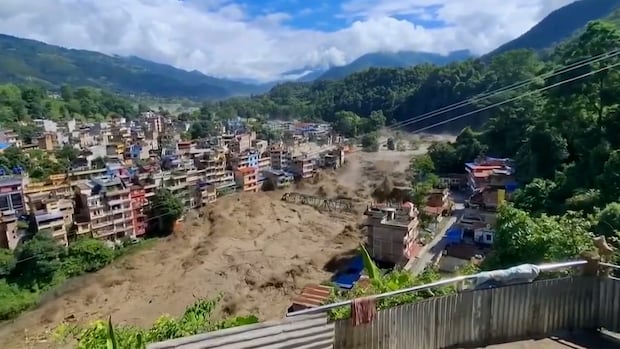
Rescue workers are scrambling to find survivors after a massive flash flood at the Nepal-Tibet border left at least 150 people dead and hundreds missing, including 24 Canadians.
According to Nepal police spokesperson Abi Narayan Kafle, at least 28 police officers are also among the missing.
Nepal’s steep valleys serve as vital economic corridors, but they become precarious during disasters. Images depicted what appeared to be the upper floors of buildings in the severely affected Nuwakot district covered in mud after the floodwaters surged. Debris hung from tree branches and wires, vehicles were buried, and shocked survivors were coated in mud.
Preliminary reports from Nepali officials indicated that an earthquake in the vicinity might have triggered the collapse of a glacier, leading to the flooding. The U.S. Geological Survey later clarified that the tremor recorded at the time resulted from the collapse of glacial rock and ice onto the valley floor.
The Trishuli River runs parallel to a highway north of Kathmandu, which is frequently used to access one of Nepal’s most sought-after trekking destinations in the Langtang region.

Rescue efforts are underway after an earthquake struck the mountainous Rasuwa district in Nepal. Officials say around 400 tourists and travellers — including from India, the U.K. and Malaysia — are missing as crews attempt to reach villages where homes are covered in mud.
China and India ready to assist
The United Nations and its partners are mobilizing resources and personnel in Nepal to assist communities impacted by the disaster, as stated by UN Secretary General António Guterres.
Chinese President Xi Jinping has instructed authorities to intensify efforts to locate individuals missing after the mudslide, according to reports from state news agency Xinhua. Large-scale search and rescue operations are being conducted by Chinese authorities in the Tibetan border region of Gyirong, as per state broadcaster CCTV.
Indian Prime Minister Narendra Modi communicated with Nepali Prime Minister Balendra Shah, offering assistance.
“India is ready to provide all types of humanitarian aid to Nepal. Our teams are coordinating closely on rescue and relief efforts,” Modi announced in a social media update.
In Nuwakot, one of the areas most severely affected, numerous multi-storey buildings, trucks, and vans were engulfed by massive amounts of mud. Officials have cautioned residents in various districts of Nepal and urged them to avoid the banks of the Bhotekoshi, Trishuli, and Narayani rivers.
The regions impacted by Wednesday’s disaster previously experienced flash floods similar to those in August of last year, when a glacial lake in Tibet overflowed due to elevated temperatures in the mountainous area. At that time, nine lives were lost, and critical infrastructure, including a bridge linking Nepal and China, was damaged.
Climate experts from the Kathmandu-based International Centre for Integrated Mountain Development have suggested that an avalanche from a glacier likely triggered the flash flood on Wednesday.
The Lhende Khola River, which is a tributary of the Bhotekoshi River, experienced the most severe flooding on Wednesday, they reported.
Saswata Sanyal, a disaster risk reduction specialist at the climate research group, explained, “The Lhende Khola has flooded twice within 14 months, this time due to an ice rock avalanche from a glacier on the Nepal side that blocked the river, leading to a sudden surge downstream.”
He added, “In a warming Himalaya, early warning systems are the first line of defense against adaptation.”
The Himalayan region, spanning Nepal and several neighboring countries including India, is particularly susceptible to intense rainfall, flooding, and landslides due to the area warming at a rate faster than the global average as a result of human-induced climate change.
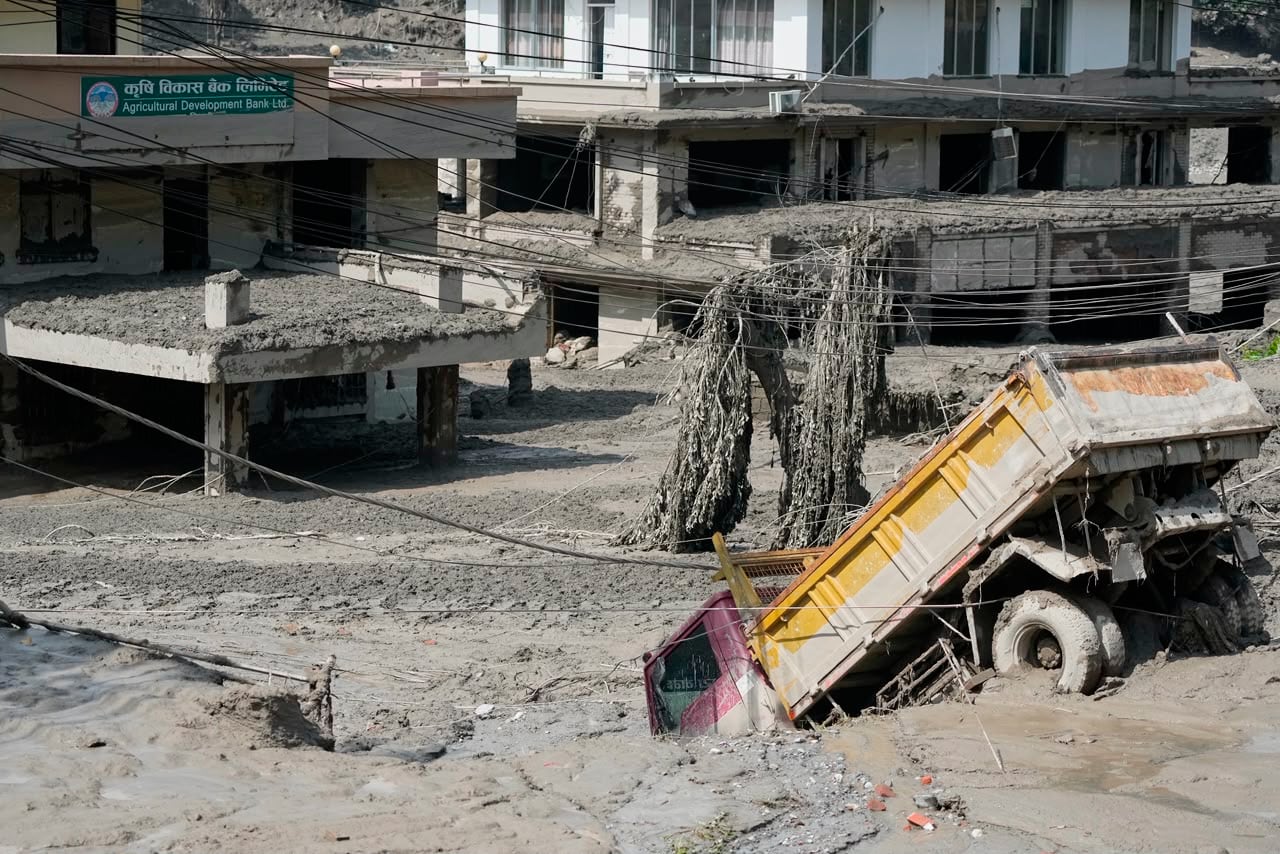
Damaged houses and vehicles are seen in the aftermath of flash floods along the Trishuli River in Nepal’s Nuwakot district on Wednesday. (Niranjan Shrestha/The Associated Press)
Research indicates that extreme weather phenomena, such as heatwaves, heavy precipitation, and glacier melt, are occurring more frequently in the region.
Earlier this year, researchers from the Kathmandu research group found that glaciers across the Hindu Kush Himalaya region are melting at an accelerated pace, with ice loss rates having doubled since 2000, primarily due to increasing global temperatures and climate change.
