
On Monday, the administration of U.S. President Donald Trump declared an expansion of secondary sanctions that can be enforced against entities and nations maintaining commercial relationships with Iran, significantly increasing economic pressure on Tehran as the conflict approaches its six-month anniversary.
During a press briefing, Treasury Secretary Scott Bessent introduced what he referred to as an “economic D-Day,” intended to serve as a final alert for countries to cut business ties with Iran or face the consequences of having major companies and organizations excluded from the dollar-based financial system.
“We are initiating an economic offensive against Iran’s financial networks worldwide. Our goal is to cut off every economic lifeline that bolsters this oppressive regime until Tehran is isolated,” Bessent stated.
The U.S. Treasury Department announced that it has identified the networks, facilitators, and financial channels Iran employs to smuggle oil and bypass sanctions, and that Washington plans to collaborate with U.S. allies to target any source of Iran’s “illicit revenue.”
The department specified that it has issued determinations against five key sectors—digital assets, technology, gold, aviation, and shipping—that the Iranian government relies on to support its economy. Additionally, the Treasury has placed sanctions on nearly 60 entities, individuals, and vessels.
For several years, China has been the largest purchaser of Iranian oil. Washington has increased efforts to restrict Chinese purchases but has yet to officially designate larger Chinese banks that might be facilitating the trade.
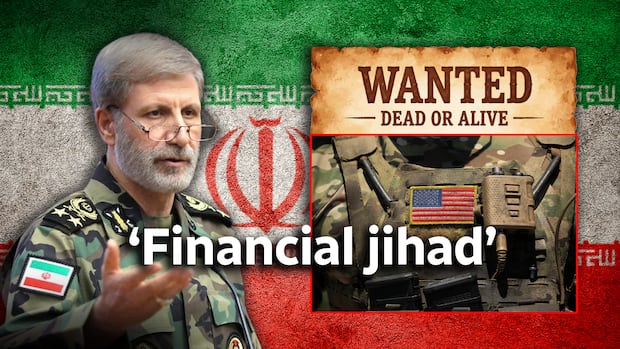
Iran is offering a $30,000 US bounty to any Iranian who can capture or kill American soldiers. Andrew Chang breaks down why the timing of the announcement matters, its propaganda value, and how realistic it actually is.
(Photo credits: The Canadian Press, Reuters, Adobe Stock and Getty Images)
‘Wait for an attack,’ Iran warns
Prior to the announcement, Iran issued threats of a potential military response and a further decrease in oil exports from the Gulf in reaction to any U.S. economic actions.
Following the announcement, Iranian Finance and Economic Affairs Minister Ali Madanizadeh remarked, “We are entirely ready for the U.S. sanctions.”
“Of course, the adversaries aim to launch an economic terrorist attack against us, but we also possess our own strategies and understand how to navigate the situation. Our defense is no longer merely defensive; the adversaries should anticipate an offensive,” Madanizadeh stated during an interview with state television.
Brigadier General Hossein Mohebbi, a spokesperson for Iran’s Islamic Revolutionary Guard Corps (IRGC), promised significant retaliation against U.S. vital interests and energy choke points if Iran’s infrastructure is threatened, as reported by Press TV.
The U.S.-Iran conflict is nearing its six-month mark, contributing to rising energy prices globally. Although heavy combat has decreased, diplomatic efforts to resolve the conflict have stalled, and oil and raw material shipments through the Strait of Hormuz remain obstructed, keeping energy prices high.
Trump’s approval ratings have dropped to a record low, with only 33 percent of Americans in the latest Reuters/Ipsos poll expressing approval of his performance. He claims that the economic hardships are essential to prevent Iran from acquiring nuclear weapons.
The U.S. has enforced sanctions against Iran for several decades, primarily targeting the nation’s oil income, restricting its aviation sector and cryptocurrency activities, limiting its acquisition of weaponry components and other military hardware, and cutting off funding for businesses controlled by the IRGC, a major player in the Iranian economy.
These sanctions prohibit designated entities from accessing the dollar-based financial system, but Iran has effectively established new front companies, entities, and vessel registrations to circumvent them.
