
The United Nations reported on Monday that a gang assault on a neighborhood overlooking Port-au-Prince, Haiti’s capital, resulted in at least 47 fatalities and 22 injuries. This incident has raised public outrage regarding the inadequate protection against continuous violent attacks.
According to the United Nations Integrated Office in Haiti, these numbers might still be subject to revision.
Jean Massillon, the mayor of Kenscoff, stated that armed individuals invaded the area late Sunday, igniting homes and killing local residents.
This hillside neighborhood, which overlooks routes into the capital, has endured a series of assaults by armed groups since last year, compelling thousands to vacate their residences.
Over the years, powerful gangs, united in a broad coalition, have solidified their hold over Port-au-Prince while also extending their reach to surrounding areas, despite international efforts to bolster the under-resourced police force.
While Haiti’s government condemned the “barbaric attack” and vowed to enhance security, residents called for the resignation of the local police chief, arguing that law enforcement failed to protect those who lost their lives mere minutes from the police station.
“Kenscoff will not be abandoned,” the prime minister’s office declared via social media. “The government’s authority will be restored swiftly and decisively.”
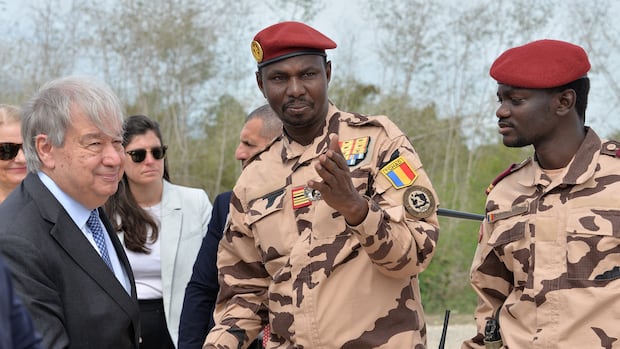
CBC’s Paul Hunter accompanied UN Secretary-General António Guterres on a visit to Haiti’s perilous, gang-controlled capital, Port-au-Prince, where a newly established UN-backed Gang Suppression Force is striving to mitigate violence and restore order. | CORRECTION (June 18, 2026): An earlier version of this video and description referred to this mission as a UN force. In reality, it is a multinational initiative supported by the United Nations.
‘They sowed chaos’
In Kenscoff, cries of despair echoed as survivors discovered the remains of friends and family scattered across the streets early Monday.
“They killed my son!” a woman cried out repeatedly while others nearby attempted to console her.
A man collapsed on the roadside, resting his head on his arm as he wept on the ground. Meanwhile, others collected the bodies of the deceased, some covered with blood-stained sheets.
Robert Jean recounted hearing gunfire before dawn and desperately trying to awaken people to prevent further casualties. He was searching frantically for his brother, who was killed, saying, “I was calling to see if everyone was safe. I could not find my brother.”
Another local resident held the government accountable for the violence. “If we had a competent police force that could have stationed an armored truck here, this tragedy might have been averted,” stated Verti Enold-Saint while covering his brother-in-law’s body with a sheet.
Mathurin Pierre, a 41-year-old farmer, shared with The Associated Press that he lost 14 family members, with an uncertain number still unaccounted for.
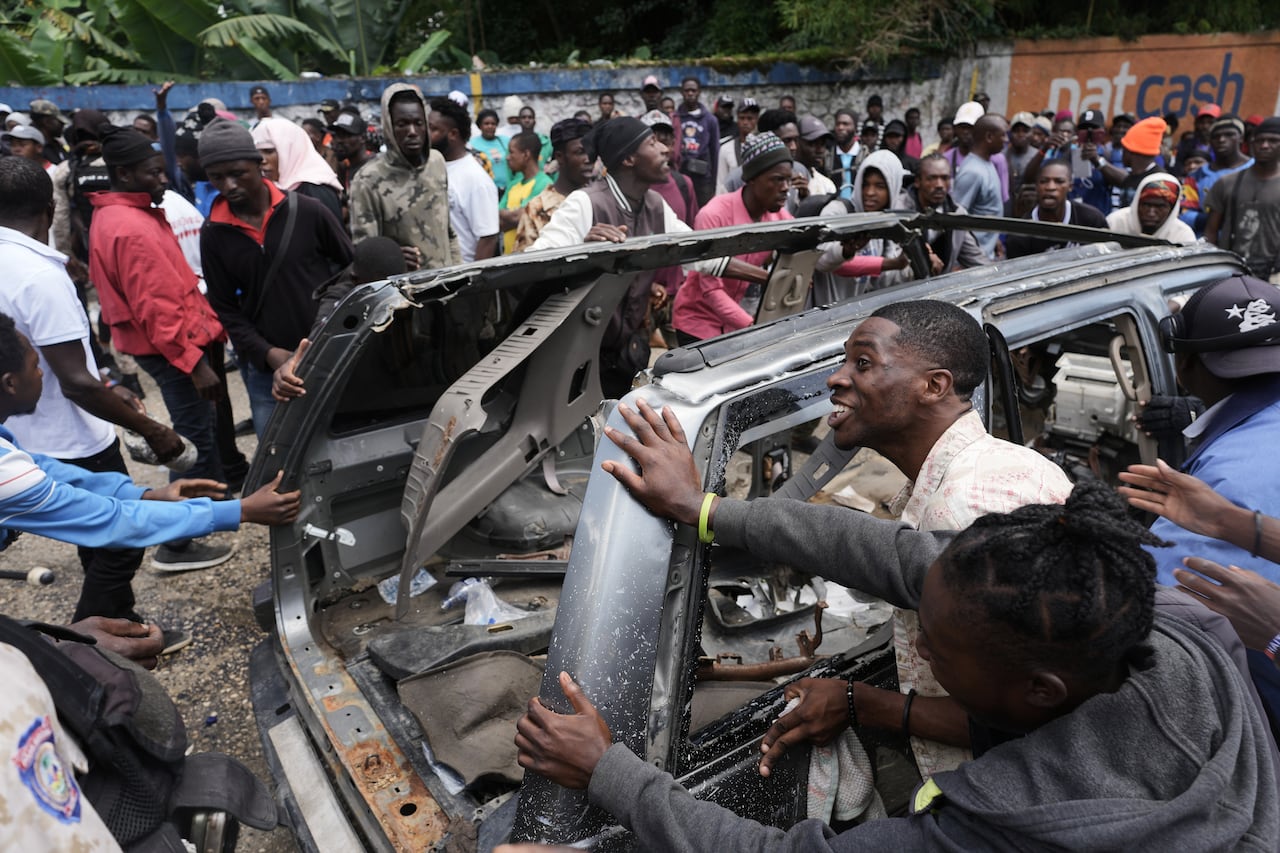
Kenscoff residents attempt to overturn a car to block a street, demanding police action in the aftermath of the deadly assault. (Odelyn Joseph/The Associated Press)
Massillon attributed the attack to members of Viv Ansanm, which was designated as a foreign terrorist organization by the U.S. government last year.
“They sowed chaos,” Massillon remarked.
He indicated that gang members targeted a church as well as residences, including those belonging to Dr. Jean (Bill) Pape, a prominent physician running a non-governmental organization in Haiti that assists patients, including those with HIV and tuberculosis.
Gangs are believed to control around 70 percent of Port-au-Prince, with Viv Ansanm frequently assaulting the nearby Kenscoff.
The violence perpetrated by gangs has led to the displacement of a record 1.5 million individuals throughout Haiti, where over 3,100 people were reported killed from January to June, along with another 1,189 injuries, according to UN data.
WATCH | Ottawa urged to protect Haitian refugees fearing deportation to U.S.:

In June, the U.S. lifted protections that had prevented the deportation of Haitians. Now, advocates are urging Canada to reconsider its Safe Third Country Agreement with the U.S. for Haitians seeking asylum.
This assault occurred just days after the U.S. government deported over 160 individuals to the unstable Caribbean nation, marking the first such action since the Trump administration successfully ended temporary protected status (TPS) for approximately 350,000 Haitians.
The Haitian government has indicated that some of those deported were TPS holders living legally in the U.S., along with individuals of Haitian descent who were not born in Haiti. The U.S. Department of Homeland Security confirmed in a statement to the AP on Monday that those deported last Friday included several gang members with criminal records for offenses such as assault and drug trafficking.
Haiti is set to conduct general elections for the first time in over a decade on December 13, with efforts underway to register voters in Port-au-Prince and beyond. However, experts caution that the current climate is too perilous for elections to be held safely.
