

Franz Bender successfully persuaded a thousand individuals to bury their underwear — and it wasn’t for any bathroom-related reason.
In 2021, the Swiss soil ecologist and his research team enlisted 1,000 citizen scientists to bury and later excavate underwear across Switzerland, aiming to gain insights into soil and its health. In September, their project received an Ig Nobel Prize, which honors research that elicits both laughter and contemplation.
The initiative revealed unexpected findings for both the researchers and participants when they unearthed the underwear, often reduced to little more than remnants by the voracious soil microbes.
“The moment when individuals excavated the underwear and examined it was quite revealing for many,” Bender, affiliated with the Agroscope agricultural research center in Zurich, shared with Quirks & Quarks host Bob McDonald.
“It’s intriguing to witness that soil is indeed alive, teeming with life below the surface that we typically overlook.”
The findings of this research were published in Plants People Planet in August 2026.
However, Bender is not the first to bury underwear. The practice actually originated in Canada.
The Innovative Farmers Association of Ontario began the practice of burying underwear in Ontario fields around 2015, according to farmer Alan Kruszel. While people had long buried cotton strips referred to as assays, farmers decided that underwear would add a fun twist.
It proved to be such an enjoyable activity that Kruszel proposed expanding it nationally. Thus, in 2017, the national “Soil Your Undies” campaign was launched.
“It was an incredible success,” Kruszel, a board member of the Soil Conservation Council of Canada, remarked to Quirks & Quarks.
“The goal was to encourage people to recognize soil as a living ecosystem and to highlight the significance of soil health.”
-
Okanagan grape growers say crop insurance model failing amid wildfire smoke taint
-
This is how fast Swiss glaciers, the ‘water tower of Europe,’ are melting away
Moreover, it wasn’t solely farmers and soil scientists who participated in this quirky initiative.
“I buried underwear with a diverse group of individuals. We involved senators, university deans, schoolchildren, and even collaborated with the Canadian Ag Museum in Ottawa,” Kruszel noted.
“Garden clubs … you can’t imagine the joy a group of elderly ladies experienced while showcasing soiled underwear.”
A colleague of Bender noticed the enthusiasm and proposed conducting a similar event in Switzerland. They organized a small gathering where families buried underwear in the soil.
“The Swiss media embraced it wholeheartedly. It received extensive coverage,” Bender recounted. “Then another collaborator approached us with the idea of launching a citizen science project based on this and expanding it significantly.”
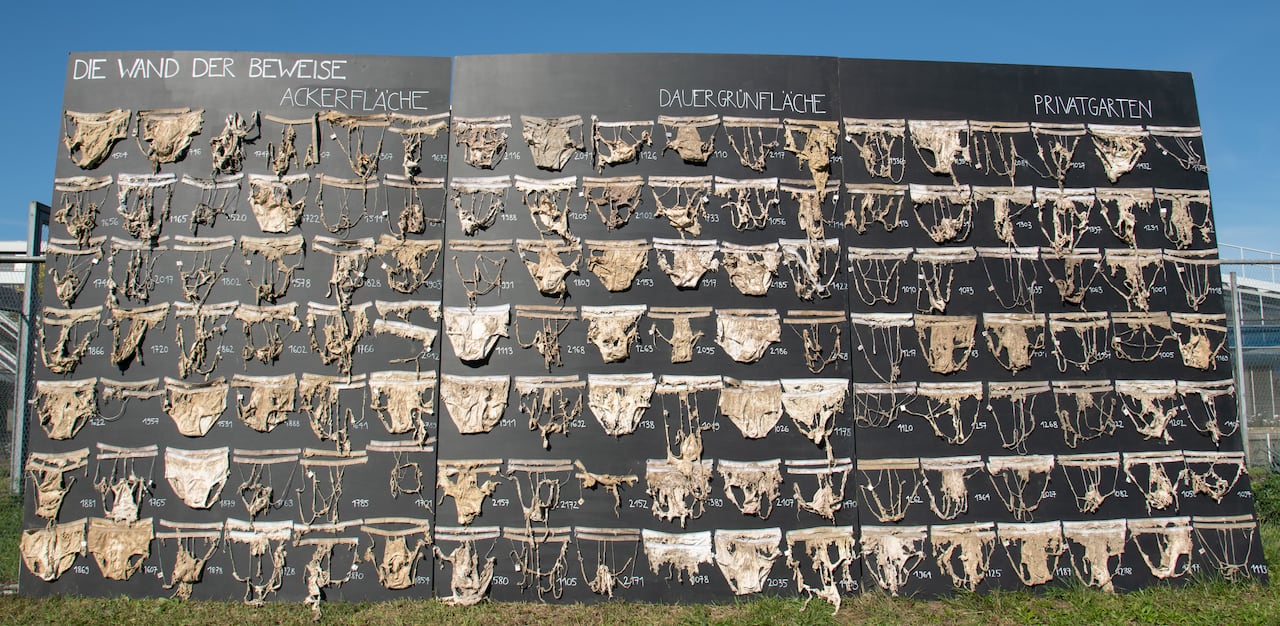
Results of underwear buried in soil in arable land, lawns, and gardens on display in Switzerland. Soil ecologist Franz Bender said the study showed the underwear had the most decomposition in gardens and the least in lawns, with arable fields and grasslands in between. (Prisca Koller/Agroscope)
Bender and his team required 1,000 citizen scientists, but received around 1,400 applications, necessitating a selection process to ensure geographic diversity across Switzerland. The team sent volunteers two pairs of size small organic cotton underwear, 12 teabags for comparison, along with detailed instructions.
“We provided clear diagrams illustrating how to bury them, at what depth, and where to place the teabags,” Bender explained.
Additionally, the team created a smartphone app enabling participants to upload extra information, including photos, geographical data, and details regarding the land, such as fertilizer use or application of pesticides.
The citizen scientists were instructed to excavate one pair of underwear and one set of teabags after four weeks, with the second pair and remaining teabags dug up after eight weeks.
Microbes feast on underwear
While underwear may not seem like a desirable meal, for the microbes and other organisms in rich, biologically active soil, it was a treat. In contrast, underwear retrieved from other soil types appeared nearly intact.
“In some cases, only the synthetic threads at the waistband remained. The underwear was entirely consumed,” Bender noted. “Meanwhile, in other instances, the underwear appeared almost new.”
Overall, the greatest decomposition of underwear occurred in private gardens and flowerbeds, while lawns exhibited the least. Arable fields and grasslands fell somewhere in between.
Bender clarified that gardens often contain ample compost and possibly irrigation, creating nutrient-rich and moist soil conditions. This fosters biological activity, resulting in thoroughly degraded underwear.
Conversely, lawns tend to lack species diversity above ground and undergo frequent mowing. Consequently, the soil system beneath lawns is less vibrant and active than in gardens, leading to some underwear buried in lawns appearing dirtier rather than consumed.
-
Here’s why southern Ontario farmers are supporting a new bill to make soil a national asset
-
Audio
Sask. soil has improved by about 40% over the last 3 decades, study finds
However, some surprising outcomes emerged. Bender expressed astonishment at the high nutrient content in private gardens and the unexpectedly low decomposition rates of underwear in agricultural soil.
Bender also warned that more active, fertile soil does not always equate to “healthier” soil. For instance, it can negatively affect biodiversity in forests or nature reserves.
Bender hopes to raise awareness about the vital role of soil, especially as human activities, like chemical usage, impact it in unpredictable ways.
“Soil is crucial for sustaining the cycle of life, and we all rely on it,” he stated. “Without sufficient knowledge about soil, protecting it becomes challenging.”
Underwear sparks interest in soil: experts
Asim Biswas, a professor and Canada Research Chair in digital agriculture at the University of Guelph, noted that while the study is methodologically sound, its most significant contribution lies in the awareness it has generated about soil.
“It received extensive [media] coverage across 25 countries — that’s remarkable,” he commented.
“I believe this was a fantastic advocacy tool for soil because it’s humorous, and people tend to remember these types of initiatives.”
Biswas echoed Bender’s caution that more active, fertile soil isn’t always healthier, and emphasized that further research is needed in this area.
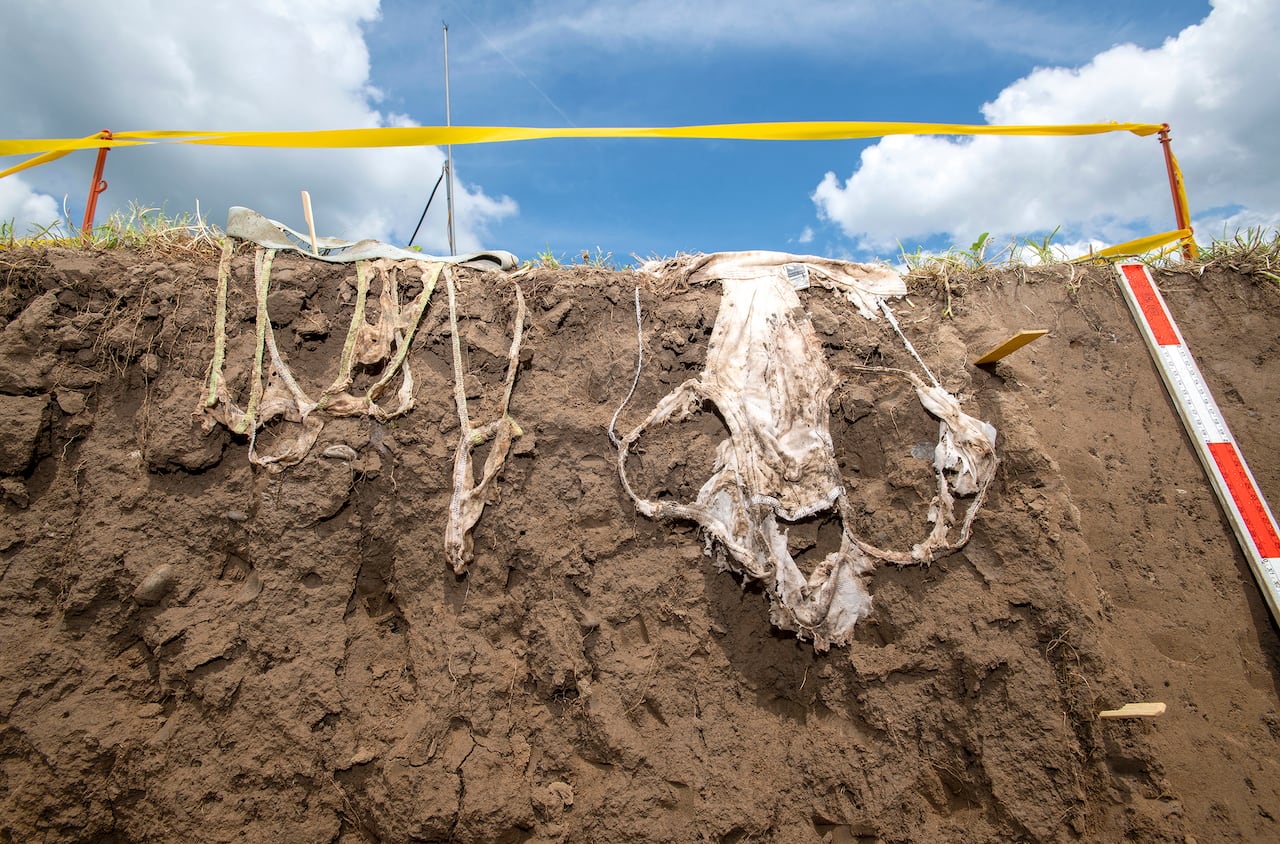
Soil scientists assert that burying and retrieving underwear can serve as an effective measure of soil biological activity, while also sparking public interest in soil issues. (Gabriela Braendle/Agroscope)
Joann Whalen, a McGill University professor specializing in soil research, mentioned that this method provides a simpler, quicker, and more cost-effective alternative to conventional chemical laboratory tests.
“Sometimes, individuals may be curious about their soil but lack the opportunity or resources to test it,” she noted.
“Using a visual test like this, where one can observe the degradation of the underwear, offers a quick insight into the soil’s condition.”
The Soil Conservation Council of Canada is also supportive of this initiative and offers guidance.
Moreover, the unearthed Swiss underwear will have a new purpose. Bender and his team are collaborating with a fashion designer who has already crafted a dress using some of the buried items.
“More fashion items will emerge from this project,” Bender commented.
